
Complimentary insured UK delivery
Jewel of London

Diamond education

Moissanite vs Lab-Grown Diamonds: Appearance, Properties and Price

Compare moissanite vs lab-grown diamonds by material, appearance and documentation, with practical buying questions.
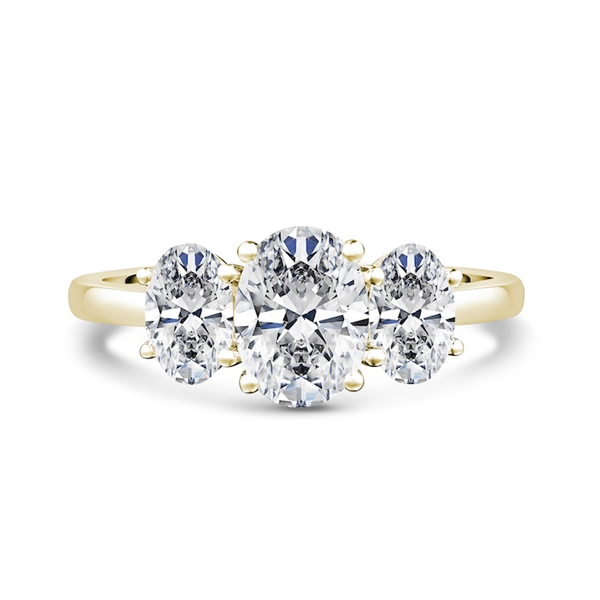
Oval trilogy engagement ring in yellow gold

Moissanite vs lab-grown diamonds is a comparison between different materials. A laboratory-grown diamond is diamond. Moissanite is silicon carbide, which can resemble diamond but has different properties.

Both can be used in jewellery. The important point is that a listing should identify the material clearly so you can choose knowingly and compare like with like.

Moissanite vs lab-grown diamonds: material first

“Lab-grown” describes the origin of a diamond, rather than a category containing every manufactured white gemstone. Calling moissanite a lab-grown diamond would therefore be incorrect.

GIA's guide to simulants distinguishes diamond from materials used to imitate its appearance. A phrase such as “diamond look” does not replace an explicit material description.

Read the specification before interpreting the price, photograph or marketing name.

Compare the appearance you enjoy

Moissanite and diamond can both appear lively, but their response to light differs. Compare actual examples under ordinary light as well as brighter lighting. A video showing strong flashes may exaggerate the feature a seller wants to emphasise.

View the stones at normal scale. Large magnified images are helpful for detail, yet the impression on the hand may be quieter. If you have a strong preference about coloured flashes or facet patterns, judge it through direct comparison rather than a general statement that one material “sparkles more”.

Use measurements instead of ambiguous weights

Some alternatives are described using diamond-equivalent weight. That is intended to communicate an approximate diamond-like size; it is not necessarily the material's measured carat weight.

Ask for length and width in millimetres and whether any quoted weight is actual or equivalent. Two listings can appear to offer the same “carat size” while using different conventions.

For the underlying distinction, read the carat guide.

Check the documentation

A diamond report should identify the material and origin within its scope. A card accompanying another gemstone is not automatically equivalent to a diamond grading report.

Look for a clear statement on the invoice and order confirmation. If a seller uses a proprietary name, ask what gemstone that name represents. Avoid relying on a basic tester as the only method of material or origin identification.

Compare finished jewellery, not only stones

The same-looking ring may differ in metal fineness, band dimensions, stone size and setting construction. When comparing prices, record the entire specification and any included services.

This guide does not assign a permanent price ratio to the two materials. Obtain current quotations and compare what you would actually receive. The cheaper offer may be appropriate for your priorities, but it should not be mistaken for the same product.

Common questions

Is moissanite a lab-grown diamond?

No. They are different materials, even when both have been produced in controlled environments.

Can either material be identified from a photograph alone?

A photograph is not a reliable identification method. Use clear documentation and qualified testing when needed.

Which does Jewel use for engagement centres?

Jewel of London's engagement selection uses lab-grown diamonds. Explore the engagement collection with that specification in mind. Understanding moissanite vs lab-grown diamonds helps you compare other offers without confusing a similar appearance with the same material.

Related reading

Diamond education

Diamond Fluorescence Explained: What Buyers Should Know

Understand diamond fluorescence, what a report records and why the stone's appearance in ordinary light matters.

Oval trilogy engagement ring in yellow gold

Diamond fluorescence is a response to ultraviolet light. Under suitable conditions, a diamond may emit visible light, often blue. The presence of that response does not automatically tell you whether the stone will look attractive in everyday wear.

The practical task is to understand the report description and inspect the actual diamond. A simple rule to reject or favour every fluorescent stone misses that distinction.

What diamond fluorescence describes

Where fluorescence is recorded, the report may describe the strength of the response under the laboratory's testing conditions. This is separate from the ordinary reflections that make a diamond sparkle.

Fluorescence is also different from clarity. A fluorescence label should not be treated as a replacement for inspecting transparency, inclusions or the stone's general appearance.

GIA's explanation discusses how fluorescence and viewing conditions interact. The effect is not identical in every diamond.

Look under more than one kind of light

A stone may look different in daylight, office lighting and concentrated jewellery lighting. Those conditions differ in more than brightness; their ultraviolet content can differ too.

Ask to see the actual diamond in several ordinary settings where possible. Watch for an appearance you dislike, such as persistent haze, and ask a qualified professional to assess the cause. Do not assume fluorescence explains every cloudy-looking photograph.

A dirty surface, camera exposure or other stone characteristics can also affect an image. The seller should address the specific observation rather than repeat a blanket claim.

Separate report colour from perceived colour

A laboratory colour grade is determined under controlled conditions. The impression of colour when worn is influenced by the surrounding environment and the stone itself.

Therefore, a description of fluorescence does not replace the colour-grade information. Keep both pieces of information in their proper roles and avoid treating either as a guaranteed prediction of every viewing situation.

Compare equivalent stones before discussing price

If fluorescence appears to explain a price difference, check the rest of the specification first. Measurements, clarity characteristics, report type and finishing may differ as well.

Ask for a comparison that isolates the feature as far as practical. Two unrelated photographs with different backgrounds will not do that. Current quotations for similar stones are more useful than a fixed percentage adjustment quoted as a universal rule.

Do not use fluorescence to establish origin

Ultraviolet response is not a reliable home method for deciding whether a diamond is natural, lab-grown or a simulant. Origin identification requires appropriate testing and interpretation.

For Jewel's lab-grown engagement centres, use the product description and the supplied documentation. If an origin question remains, ask for clarification rather than attempting to resolve it with a consumer UV torch.

Common questions

Is fluorescence always bad?

No. The actual appearance and the buyer's preference matter. A label alone does not settle the decision.

Does no fluorescence guarantee a clear-looking diamond?

No. Transparency, cleanliness and other characteristics still need assessment.

Should I choose a fluorescent diamond?

Choose a stone whose documented specification and observed appearance suit you. Diamond fluorescence is one feature to understand, alongside the wider diamond-quality guide, rather than the whole buying decision.

Related reading

Diamond education

Diamond Cut vs Shape: What Is the Difference?

Understand diamond cut vs shape, including outlines, proportions and light performance, before comparing engagement diamonds.

Oval trilogy engagement ring in yellow gold

Diamond cut vs shape can be confusing because everyday descriptions use “cut” in more than one way. “Oval cut” may identify an outline, while “excellent cut” may refer to a particular assessment. Those phrases answer different questions.

Shape describes the overall form you see from above. Cut quality concerns how the diamond has been fashioned, including proportions and finishing that influence its appearance.

Diamond cut vs shape in practical terms

Round, oval, pear and marquise are recognisable outlines. Emerald and radiant are names that also convey particular cutting styles. A shape label alone does not establish that a diamond performs well in light.

Start by choosing silhouettes you enjoy. Then assess the individual diamonds within that group. Two ovals can share an outline category while showing different brightness, contrast and proportions.

Browse the shape guide for design comparisons, then ask for actual-stone information when selecting a centre.

Understand what makes the light change

A faceted diamond redirects light through its surfaces. The arrangement and angles of those facets influence the mixture of bright reflections, coloured flashes and contrast you see as it moves.

GIA's cut guide explains these effects. A stone should not be judged from a single still image, because a well-chosen moment can hide areas that look less lively at other angles.

Compare videos recorded under similar conditions where possible. Also consider how the diamond appears in ordinary light, rather than only under strong spotlights.

Read grading terms accurately

An overall cut grade is not the same as a polish grade or symmetry grade. Polish concerns surface finishing; symmetry concerns aspects of alignment and arrangement. Both matter, but together they do not automatically describe the complete face-up appearance.

Report scope varies with laboratory, service and shape. Check exactly which assessments appear. Avoid taking the word “excellent” from one part of a listing and applying it to every aspect of the diamond.

Fancy shapes need individual judgement

A length-to-width ratio helps describe an elongated outline. Table and depth measurements add information about proportions. None should be treated as a universal pass-or-fail formula across all cutting styles.

Look for an outline you enjoy and a pleasing pattern as the stone moves. Consider whether dark areas change with angle or remain visually dominant. The aim is a balanced appearance, not the complete absence of contrast.

Keep the mounting in mind

The chosen shape affects claw positions, tip protection and the ring's footprint. A pear needs a setting designed for its pointed end; a round requires a different arrangement.

The setting should work with the actual stone dimensions. A desirable shape and a good report do not remove the need to assess the finished ring's height, band width and wedding-band clearance.

Common questions

Does round automatically mean better cut?

No. Round describes a shape. Individual round diamonds still differ in proportions and quality.

Does excellent polish mean excellent overall cut?

Not by itself. Read each assessment within the laboratory document's scope.

Should I choose shape or cut quality first?

Shortlist shapes first, then compare the individual stones carefully. Understanding diamond cut vs shape helps you explore Jewel's engagement designs without confusing style preference with quality.

Related reading

Diamond education

What Is an Eye-Clean Diamond? Understanding Clarity

Learn what an eye-clean diamond means, how clarity differs from everyday appearance and which questions to ask the seller.

Oval trilogy engagement ring in yellow gold

An eye-clean diamond has no inclusions visible to the unaided eye under the viewing conditions being described. It is a practical description, rather than one of the formal clarity grades on a laboratory scale.

Those conditions matter. Viewing distance, lighting, eyesight and whether you look from the top or side can change what you notice. Ask a seller to explain what they mean instead of assuming everyone uses the term identically.

An eye-clean diamond is assessed at normal scale

Magnified photographs are useful for identifying features, but they can make a small inclusion appear dominant. A mark that fills a screen may be difficult to see when the diamond is worn.

Review both enlarged and realistic views. If possible, inspect the actual stone at a normal distance before returning to the magnified image. This keeps the detail in proportion without dismissing anything that needs closer attention.

Clarity grades answer a different question

Laboratories assess clarity using defined examination conditions. Characteristics can include internal inclusions and surface blemishes. Their size, position, number, nature and contrast contribute to the assessment.

GIA's clarity guide explains the formal framework. A grade is valuable evidence, but it is not a guarantee that every stone in that grade looks identical without magnification.

For that reason, avoid promises that a particular grade is always eye-clean. The individual diamond remains the unit of comparison.

Position can matter as much as the label

A dark feature near the centre may attract attention differently from a pale feature near the edge. Facet pattern can also make a characteristic easier or harder to see.

Step-cut diamonds have broad reflections that invite a different kind of inspection from many brilliant cuts. Rather than choosing a fixed clarity grade for every shape, review the actual appearance of the selected stone.

The diamond-shape guide can help you understand why those viewing experiences differ.

Separate visibility from durability

A feature that is difficult to see is not automatically irrelevant to durability. Conversely, a visible inclusion does not automatically mean the diamond is unsuitable.

Ask the jeweller or qualified gemmologist to assess any characteristic that approaches the surface, an exposed point or a vulnerable edge. Do not try to judge structural risk from a tiny report diagram alone.

The setting should protect the stone appropriately. It should not be used to conceal an unresolved question about its condition.

Use a precise buying checklist

Ask whether the diamond is eye-clean from the top at a stated distance, and whether any feature is noticeable from the side. Request actual-stone imagery where available.

Then confirm the laboratory grade, report number and any relevant durability assessment. Finally, compare the difference in price with another diamond that meets your visual preference. The aim is a considered choice, not automatically the highest available clarity.

Common questions

Is eye-clean the same as flawless?

No. A diamond can contain characteristics visible under magnification while appearing clean to the unaided eye.

Can lab-grown diamonds have inclusions?

Yes. Laboratory origin does not guarantee an absence of clarity characteristics.

Should I choose clarity before everything else?

No. An eye-clean diamond still needs attractive proportions, clear documentation and a suitable setting. Review the complete engagement-ring specification before deciding.

Related reading

Diamond education

Diamond Colour Grades Explained: What Can You See?

Understand diamond colour grades and how lighting, shape and metal affect appearance when comparing individual stones.

Oval trilogy engagement ring in yellow gold

Diamond colour grades describe assessed colour within a defined grading system. They are useful for comparison, but they do not tell you exactly how a mounted stone will look in every room or photograph.

A diamond can reflect its surroundings, and small differences may be difficult to judge outside controlled conditions. Use the grade to understand the specification, then assess the appearance you actually prefer.

How diamond colour grades work

The familiar GIA D-to-Z scale begins at D and describes increasing colour within its applicable range. Grading involves controlled lighting and comparison with reference stones. Fancy-coloured diamonds require a different approach.

GIA's colour guide explains the scale and examination conditions. The important buying distinction is between an assessed body colour and the changing reflections you see in normal wear.

A photograph with a yellow reflection does not, by itself, establish a low colour grade. Equally, a bright photograph cannot replace a laboratory assessment.

Compare similar shapes under similar light

Keep the comparison controlled enough to be useful. View stones against a neutral background and, where possible, under the same lighting. Avoid comparing a studio photograph of one stone with a phone image of another.

Shape and facet pattern influence how colour is perceived. A long outline or a broad step-cut facet can present colour differently from a round brilliant. Look at the actual stones instead of transferring a rule from one shape to another.

Consider the metal around the diamond

Yellow and rose gold create a warm setting, while platinum and rhodium-plated white gold create a different surrounding colour. These effects belong to the design; they do not change the diamond's laboratory grade.

Try to see a comparable stone in your preferred metal. A loose diamond on a white tray and a mounted diamond on the hand are different viewing situations. The metal guide helps you consider the overall palette.

Think about neighbouring stones

For a trilogy or halo, the centre sits beside other diamonds. A visually harmonious group may matter more than pursuing the highest possible centre grade in isolation.

Ask how the stones will be matched. Matching involves appearance, size and pattern as well as the stated grade. An exact letter match is useful information, but it does not guarantee that all stones will look identical in every light.

Keep report formats in view

Not every current laboratory document uses the same grading presentation. Check the issuing laboratory, stone origin and service. Do not assume a natural-diamond colour scale appears unchanged on every lab-grown assessment.

For Jewel's lab-grown engagement centres, review the specific product details and supplied documentation. If a colour option is named in the selector, make sure the confirmed order records the chosen specification.

Common questions

Do I need the highest colour grade?

That is a preference and budget decision. Compare the visual difference under useful conditions before paying for a distinction you may not notice.

Can yellow gold hide every trace of colour?

No. Metal affects the surrounding reflections, but it does not erase the diamond's body colour or make individual assessment unnecessary.

Are colour grades the same as sparkle grades?

No. Diamond colour grades describe colour; they do not replace assessment of proportions or light performance. Explore engagement designs with colour as one part of the whole ring.

Related reading

Diamond education

Centre Stone Weight vs Total Carat Weight: What Are You Buying?

Understand total carat weight for rings, earrings and bracelets. Separate centre weight from side stones and pair totals.

Oval trilogy engagement ring in yellow gold

Total carat weight is the combined weight of the diamonds included in the stated total. Centre stone weight describes one principal stone. The distinction matters whenever jewellery contains several diamonds.

A listing saying “1 ct” without explaining its scope leaves an important question unanswered. Before comparing prices, establish which stones the figure includes.

What total carat weight includes

Abbreviations include TCW and CTW. The label should explain whether the figure covers every diamond in a ring, both earrings in a pair, or all stones along a bracelet.

GIA's carat guide explains individual and combined weights. The product specification must make the grouping clear.

A total describes weight, not a particular visual size. Ten small diamonds and one larger diamond can share a combined weight while looking very different.

Read a ring specification in parts

Consider a hypothetical halo ring with a 1.00 ct centre and 0.20 ct of surrounding diamonds. Its total diamond weight is 1.20 ct. Calling it a “1.20 ct ring” does not mean the centre weighs 1.20 ct.

For a trilogy, a 1.50 ct centre plus two 0.25 ct sides produces 2.00 ct total. The sides add coverage and a different composition, but the centre remains 1.50 ct.

These are arithmetic examples, not specifications for Jewel products. Use the exact breakdown for your selected item.

Check the wording for earrings

An equal pair of solitaire studs described as 1.00 ct total contains approximately 0.50 ct per earring. A pair with 1.00 ct in each earring totals approximately 2.00 ct.

Halo earrings introduce another layer. A “combined centre weight” may exclude surrounding diamonds. The finished pair total would include the halos as well. Ask for both figures when comparing.

See the earring weight guide. The same image may illustrate several options, so the written breakdown matters.

Compare bracelets beyond the headline number

A tennis bracelet distributes weight across many stones. Equal totals can involve different lengths, stone counts and individual diamond sizes. Visible width and flexibility may differ.

Record the bracelet length, total weight, stone count where available, and approximate dimensions. Compare the setting and clasp too. A total carat figure cannot replace those construction details.

Keep origin and quality separate

Combined weight does not identify origin, colour, clarity or consistency across a matched group. Establish those independently. A larger total of small stones should not be compared with a single centre solely by adding carats.

Do not assume every accent diamond has its own report. Ask whether stated grades describe each stone, a range or a group specification, and what documents accompany the piece.

Questions to ask before ordering

Ask: “Please confirm the centre weight, side or halo weight, and total diamond weight for my selected option.” For earrings, add “per earring and for the pair.” For bracelets, include length.

Keep that breakdown with the order confirmation. It makes future discussions about the piece easier and ensures you are comparing the same thing.

Common questions

Does 2 ct total mean a 2 ct centre?

Only if explicitly stated. A multi-stone piece may divide the total among several diamonds.

Does total weight determine visible size?

No. Dimensions, arrangement and setting also affect the footprint.

Where can I compare designs?

Explore Jewel's collections and read each selected option. Total carat weight becomes useful when its scope is clear and the rest of the specification sits beside it.

Related reading

Diamond education

Diamond Carat Weight vs Size: Why Measurements Matter

Understand diamond carat weight vs size, why equal weights look different and how measurements help you compare jewellery.

Oval trilogy engagement ring in yellow gold

Diamond carat weight vs size is one of the most useful distinctions to understand before buying jewellery. Carat measures weight. Visible size depends on the diamond's outline and proportions, as well as the setting.

A carat figure should therefore sit beside millimetre measurements when you compare stones. The two pieces of information answer different questions.

Diamond carat weight vs size: what each tells you

One metric carat is 0.2 grams. A 0.50 ct diamond weighs half a carat, while a 2.00 ct stone weighs two carats. These figures do not specify a fixed diameter or length.

GIA's carat explanation sets out the unit. For visual comparison, look at the actual diamond's length, width and depth.

Do not confuse diamond carat weight with gold carat fineness. A 1.00 ct diamond set in 18ct gold uses similar wording for different measurements.

Shape changes the visible outline

A round diamond spreads its outline differently from an oval or marquise. An elongated shape may cover more of the finger in one direction, while a round creates a different balance of width and symmetry.

There is no universal winner. A long, narrow outline may appear prominent in one photograph and less substantial in another. Compare shape, length and width rather than treating one dimension as a quality score.

The shape guide helps you compare silhouettes before focusing on weight.

Depth influences where weight sits

Some weight sits below a diamond's visible top. Consequently, equal weights can have different face-up measurements. A deeper stone is not automatically better or worse; assess its complete proportions and appearance.

Chasing the widest possible outline can also lead you to overlook light performance. A diamond should look attractive as it moves, rather than meeting only a preferred measurement.

Use numbers to clarify preference

Imagine two hypothetical oval diamonds measuring 9.0 × 6.0 mm and 9.6 × 5.8 mm. The second is longer but narrower. These examples illustrate shape preference; they do not promise dimensions at a specific weight.

A length-to-width calculation gives 1.50 for the first and about 1.66 for the second. The ratio describes outline, not overall quality. You may prefer either appearance.

Allow for setting and viewing conditions

A halo increases the overall ring footprint without increasing centre weight. A broad bezel changes the visible edge. Claw position, band width and finger size also influence the impression of scale.

Ask whether an on-hand photograph shows your chosen diamond option and a comparable finger size. A life-size outline can help explain measurements, but cannot show how the actual diamond will sparkle.

Compare jewellery consistently

For earrings, determine whether weight is per stone or for the pair. For a trilogy, separate centre weight from side weight. A total across several diamonds cannot predict one centre's dimensions.

When browsing engagement designs, check the selected specification. A render may represent only one example of the available sizes.

Common questions

Does twice the carat weight mean twice the diameter?

No. Weight and linear measurements do not increase in that simple proportion.

Can I use a size chart?

Yes, as an approximate visual aid. The actual stone's measurements are more reliable.

Which number should I prioritise?

Use both. Diamond carat weight vs size is not a choice between competing measurements: weight describes mass, while dimensions explain the appearance you will wear.

Related reading

Diamond education

How to Read a Diamond Grading Report

Learn how to read a diamond grading report, verify the report number and check origin, measurements and the document's limits.

Oval trilogy engagement ring in yellow gold

A diamond grading report records characteristics assessed by the issuing laboratory. It helps identify and compare a stone, but it is not a complete judgement of how a finished ring will look or feel.

Start with the report's identity and scope. Then connect its measurements and assessments to the actual diamond.

Identify the diamond grading report first

Check the laboratory name, report number and document type. Establish whether it describes a natural diamond, a laboratory-grown diamond or a different service. Do not assume every document headed “report” contains the same assessment.

Use the issuing laboratory's official service. For example, IGI provides online verification. Match the returned details to your document rather than relying only on a screenshot.

Verification confirms the laboratory's record. Connecting that record to the actual stone still requires appropriate checks, which may include its inscription and physical characteristics.

Read weight and measurements together

Carat weight describes mass. Measurements describe physical dimensions. For an elongated diamond, length and width explain its outline; depth adds further context.

Compare those figures with the appearance you want. A larger weight does not automatically mean a proportionately larger face-up outline. Check that the shape and cutting-style description agree with your selected product.

Understand the quality information shown

Where colour and clarity grades appear, read them within the document's stated system. Review comments and any treatment information. A diagram can help locate clarity characteristics, but not every report includes one.

Cut information needs particular care. Some documents show an overall cut grade for eligible stones; others give polish and symmetry without an equivalent overall grade. Finishing grades do not describe every aspect of visual performance.

Know that formats change

GIA's revised service for D-to-Z laboratory-grown diamonds began in October 2025, using Premium or Standard overall assessments. Its current service page explains the format. Earlier GIA documents can look different.

IGI's laboratory-grown reports provide their own assessment format. Terms from different services are not necessarily one-to-one substitutes. Check the date, service and laboratory before comparing.

Separate the report from the ring specification

The laboratory document may concern a loose centre diamond. It will not necessarily describe the mounting, side-stone selection, band width, ring size or metal hallmark.

Keep a separate order specification for those details. If jewellery contains several stones, ask which have individual reports and how the total carat figure is calculated.

A grading report also differs from a purchase invoice or insurance valuation. Each document serves a different purpose. Ask what is supplied and why.

Make the final visual checks

Use the report to guide questions, then look at the diamond. Check its outline, transparency and pattern under more than one lighting condition where possible. Enlarged video reveals detail, but normal viewing distance remains important.

For a ring, assess the centre in relation to the mounting. Paperwork cannot tell you whether you prefer that combination on the hand.

Common questions

Is a report a guarantee of future price?

No. It records assessed characteristics, not a promised resale result.

Does a hallmark replace a diamond report?

No. Hallmarking concerns precious metal, while a diamond report concerns the stone within its stated scope.

What should I keep after buying?

Keep the diamond grading report, order specification and invoice together. Contact Jewel of London to clarify documentation for a selected piece.

Related reading

Diamond education

Lab-Grown Diamond Prices: Why Similar Grades Can Cost Different Amounts

Learn why lab-grown diamond prices vary despite similar grades. Compare appearance, measurements, reports and complete prices.

Oval trilogy engagement ring in yellow gold

Lab-grown diamond prices can differ even when two listings show the same carat weight, colour and clarity. Those labels describe important characteristics, but they are not the complete specification. They also do not explain every difference between retailers' offers.

Before deciding that one price is a bargain or another is excessive, check whether the stones and terms are genuinely comparable.

Compare lab-grown diamond prices on the same basis

Start with origin, exact weight, shape and laboratory. Then compare measurements, report details and what the price includes. A loose diamond, a selected centre upgrade and a finished ring are different offers.

Check whether the photograph shows the actual diamond. The same stock render may illustrate several options, while the supplied stones have different proportions. Record the precise specification beside the complete quote.

Similar grades can describe different appearances

Two diamonds can sit within the same grade while differing in inclusion position, outline and visual pattern. A feature near an edge may look different from a dark feature beneath the centre of the table.

Proportions also matter. A stone carrying more weight in depth may not provide the face-up dimensions you expect. With elongated shapes, the balance of bright and dark areas can influence preference even when headline grades match.

IGI's quality-factor guide explains report information. It should support, rather than replace, assessment of the actual stone.

Read the scope of the report

A laboratory name is not a substitute for reading the document. Check the report type, number and specific assessments shown. Different laboratories and service dates can produce different formats.

Look carefully at cut information. An overall cut assessment, a polish grade and a symmetry grade are not interchangeable. If a seller uses “excellent”, ask which characteristic it describes.

Separate stone costs from retail services

A quote may include sourcing, a particular setting, aftercare or delivery arrangements. These belong in a purchase comparison, but should be stated clearly. Do not assume a higher price includes a service that has not been promised.

Similarly, a discount percentage is meaningful only in the context of the selling price and specification. Compare the amount payable today, rather than the largest promotional saving.

Keep changing prices in perspective

Lab-grown diamond pricing can change. Compare quotations obtained at a similar time, and check how long each quote remains valid. A fixed discount or price-per-carat rule can become misleading as available stones and market conditions change.

Obtain current quotations for a short, consistent specification. Record the quote date and validity where supplied. If one offer is markedly different, ask the seller to explain the comparison before drawing conclusions.

Apply the comparison to a finished ring

Jewel of London's engagement designs use lab-grown centres. When exploring the collection, compare the full selected ring rather than the centre or setting in isolation.

Check the metal, centre option, side-stone details and confirmed extras. A price difference that seemed to concern the diamond alone may come from another part of the ring.

Common questions

Does the cheapest matching grade offer the best value?

Not necessarily. Appearance, dimensions, documentation and included services still need checking.

Does a higher price prove better sparkle?

No. View the actual diamond under comparable conditions rather than using price as a visual grade.

Should I compare price per carat?

It can be one reference point, but does not capture all quality or retail differences. Evaluate lab-grown diamond prices alongside the full specification and purchase terms.

Related reading

Diamond education

Lab-Grown Diamond Authenticity: What Buyers Can Check

Check lab-grown diamond authenticity through origin disclosure, matching documentation and professional identification.

Oval trilogy engagement ring in yellow gold

Lab-grown diamond authenticity is about confirming both the material and its stated origin. A beautiful photograph cannot establish either. The useful checks connect the seller’s description, the stone’s documentation and the diamond supplied.

The confusion usually comes from using “real” to answer two questions: what a material is, and whether it formed naturally. Keep those questions separate.

Start lab-grown diamond authenticity checks with the description

A laboratory-grown diamond has the diamond crystal structure and essentially the same core properties as natural diamond. Its growth environment can leave characteristics that specialists use to determine origin.

Commercial growth commonly uses high-pressure, high-temperature methods or chemical vapour deposition. Those names describe production methods, not a ranking of beauty. Assess a finished diamond as an individual stone.

GIA's overview of HPHT and CVD growth explains the technical distinction. Buyers need clear disclosure of origin, even if they do not memorise the machinery.

Are lab-grown diamonds real if they have inclusions?

Yes. An inclusion does not stop a diamond being diamond. Laboratory-grown stones can have internal characteristics, colour variation and differences in finishing. They are not automatically flawless because they were produced in controlled conditions.

The useful question is whether a particular stone has the quality and appearance you want. Review dimensions, documentation and actual-stone imagery where available. A render of the ring cannot establish the selected diamond's clarity.

How do they differ from moissanite?

Moissanite is a different material. It can resemble diamond, but its optical and physical properties differ. Cubic zirconia is another separate material used as an imitation.

Descriptions such as “diamond alternative” do not tell you which material is being sold. Look for an explicit name. If a listing only describes sparkle or appearance, ask for the material and origin in writing.

The GIA guide to simulants explains the distinction. A purchase should never depend on ambiguous terminology.

Will the diamond change because it was lab-grown?

Laboratory origin does not mean a diamond will turn into another material during ordinary wear. However, a diamond can still chip or sustain damage, and its setting can wear. Surface residue can also make jewellery look dull.

Care should suit the entire piece, including treatments, accompanying stones and metal. Follow the jewellery-care guidance and seek inspection if a stone moves or a claw catches. Avoid destructive home tests intended to prove authenticity.

What should the documents say?

The order description should identify the centre as lab-grown. If an individual report is supplied, it should correspond to the diamond and be verifiable with the issuing laboratory.

Not every small accent diamond comes with a separate report. Ask how the documentation relates to the centre, side stones or finished piece. A hallmark concerns precious metal; it does not replace diamond documentation.

A practical comparison

Keep a simple record of the stated origin, laboratory name, report number and measurements. Ask how the supplied stone is matched to that record. Where a report lists a laser inscription, a jeweller may be able to inspect it with suitable equipment. An inscription is one part of the identification process, so do not treat a photograph of a number as a complete authenticity test. If records conflict, resolve the mismatch before purchasing.

Common questions

Can a basic diamond tester confirm natural origin?

A basic tester is not a complete origin-identification service. Use a reputable laboratory when a reliable determination is required.

Does lab-grown mean perfect quality?

No. Quality and appearance vary, so compare the actual stone.

Does Jewel offer lab-grown engagement centres?

Yes. The engagement collection uses lab-grown centres. If you began with “are lab-grown diamonds real?”, the next step is to compare the particular diamond and setting, with origin clearly recorded.

Related reading

Your bag

Enjoy 10% off
Join our newsletter and enjoy 10% off full-price jewellery.
    Get my 10% code
    Email me new collections and offers.
    Unsubscribe anytime. Privacy
    No thanks, I’ll keep browsing