
Complimentary insured UK delivery
Jewel of London

Sizing and wedding rings

How to Choose a Wedding Band for Your Engagement Ring

Choose a wedding band for your engagement ring by checking profile, metal, width, clearance and contact points.
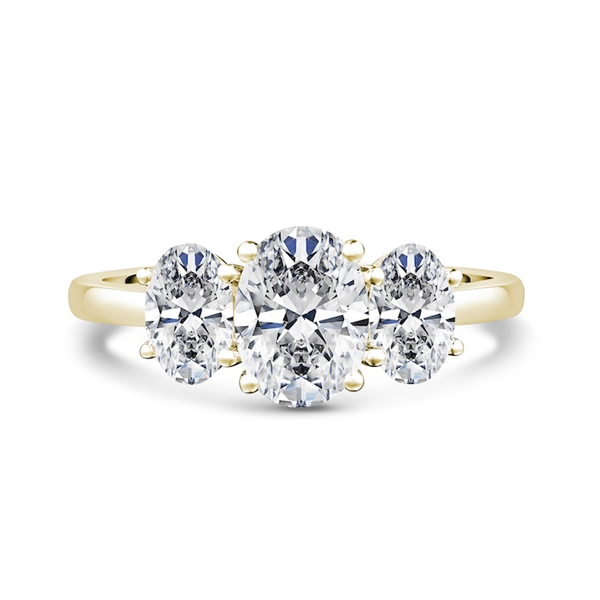
Oval trilogy engagement ring in yellow gold

Choosing a wedding band for your engagement ring starts with the profile. The two rings need to work together physically before their widths, colours and details form the look you want.

A photograph from above can suggest a good match while hiding contact beneath the centre. Review the pair from more than one angle.

Check the space around the setting

Look at the engagement ring's basket, bridge and shoulders. Identify where a straight wedding band would sit and whether it would meet metal, claws or exposed diamond edges.

A raised centre may leave useful clearance, but height alone does not guarantee a close fit. The wedding band's own height and shape matter as well.

GIA's settings guide provides terminology for these structural parts. Knowing their names makes a fitting discussion more precise.

Choose a wedding band for your engagement ring as a pair

Try the actual rings together where possible. Otherwise, request side views and relevant dimensions for both.

A straight band offers a clear line. A curved or contoured band follows more of the engagement ring's outline. A wishbone introduces an angled shape that can create space around a projecting centre.

The right choice depends on the exact geometry, not simply the centre's shape name.

Decide whether you want a gap

A visible gap can be an intentional and attractive part of a bridal set. There is no requirement that the rings touch all the way across.

If you want a close fit, avoid achieving it through pressure. The pair should not need to be forced together or push against vulnerable settings. Ask a jeweller to assess any possible contact.

Compare width and visual emphasis

A fine band can keep the centre prominent. A broader band may give the pair more presence. Diamond-set bands add another layer of reflections and may change the balance.

Look at the pair at normal scale. Two delicate rings can feel more substantial together than separately, and a broad stack may fit differently from one narrow ring.

Use the ring-size guide when assessing the combined wearing experience.

Consider metal and surface wear

Matching metal can produce a consistent palette, but mixed colours may also be intentional. Discuss how the materials and finishes will behave where the rings touch.

Do not assume any pairing is immune to wear. Diamond edges and settings deserve particular attention, as do different band heights. Regular inspection helps identify rubbing before it becomes a larger problem.

Think about wearing the band alone

You may sometimes wear only the wedding band. Check whether a strongly shaped design still suits you on its own.

Also consider future stacking. A third ring can change fit and contact points, so leave the decision open until the full arrangement can be assessed.

Explore Jewel's wedding bands beside the engagement-ring specification.

Common questions

Must the two rings use the same metal?

No stylistic rule requires it, but discuss the practical pairing and potential wear.

Does every low setting need a curved band?

No. The actual basket and band dimensions determine the fit.

What is the best starting point?

Choose a wedding band for your engagement ring by confirming comfortable clearance first, then refine the width, metal and detail.
Related reading

Sizing and wedding rings

Engagement Ring Resizing: What Affects Your Options?

Understand engagement ring resizing, including metal, stone settings, engraving and why the exact ring needs assessment.

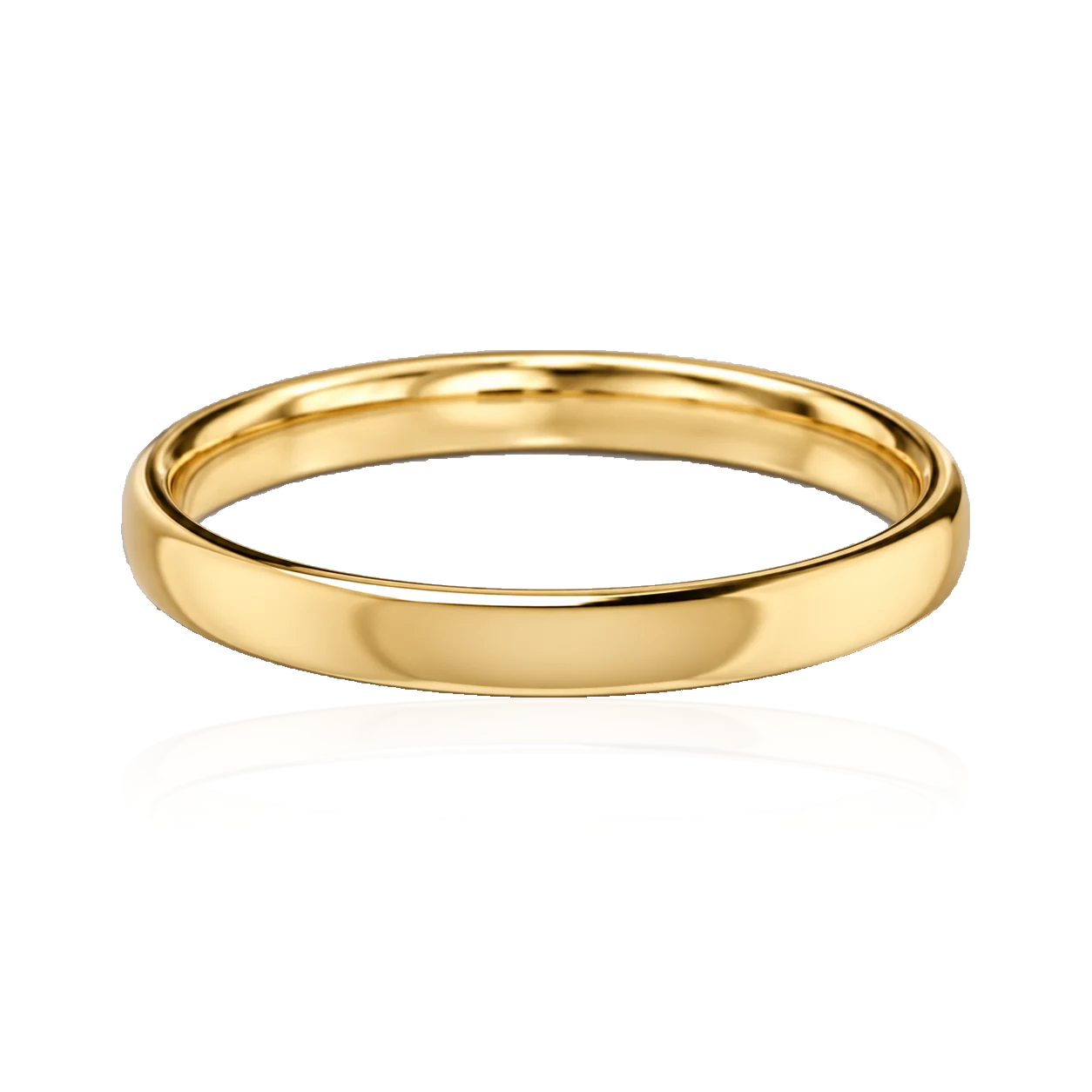
Plain yellow gold court wedding band

Engagement ring resizing is often possible, but the answer depends on the individual ring. Metal, construction, stone placement and the amount of change all affect what can be done safely.

Ask before purchasing if future adjustment matters to you. A general promise about resizing should not replace advice for the exact design and selected size.

What engagement ring resizing changes

Altering circumference changes the ring's geometry. A jeweller must consider the band and any settings connected to it, not simply make the opening larger or smaller.

GIA's workshop guidance illustrates why stone-set alterations require controlled techniques and quality checks. This is professional work, rather than a suitable home adjustment.

The process and feasibility can differ even between rings that look similar from above.

Consider where the stones sit

A plain section of band may provide more scope for alteration than a continuous circle of settings. Diamond shoulders, channels and pavé can complicate the task because changing the curve can affect stone security.

A full eternity design may need a different solution, or may not be suitable for the requested resize. Do not assume that a small numerical change is automatically straightforward.

Ask whether all stones will be checked after the alteration.

Metal and construction matter

The jeweller needs to identify the metal and alloy, including any previous repairs. Mixed-metal construction, special finishes and hollow sections can affect the approach.

A rhodium-plated white-gold ring may need its surface finish restored after work. Engraving or a continuous decorative pattern may also require attention.

Get a clear explanation of what will change visually and what will be retained.

The size of the change affects the decision

There is no universal number of sizes every engagement ring can safely gain or lose. A substantial change may alter the shape, spacing or proportion of the design.

Provide the current and desired size, then allow the jeweller to assess the physical ring. Photographs can begin the conversation but may not reveal all structural details.

Confirm the service terms

Ask about the proposed work, price, expected timing and any inspection needed. Clarify whether the piece must return to the original seller and how an alteration affects that seller's applicable guarantees or aftercare terms.

For a Jewel ring, confirm the available size adjustment and any charges before booking the work. Include the order reference and explain how the current fit feels.

Use the contact page and retain the written answer with your order records.

Check the result

After resizing, assess comfort, the ring's shape and the appearance of the finish. Ask that the settings, stone security and any engraving be checked.

If the fit remains wrong, discuss it promptly rather than accepting pressure or excessive looseness as normal. Accurate initial measurement remains preferable; see the ring-size guide.

Common questions

Can every solitaire be resized?

Many can, but the actual metal and construction still need assessment.

Is a full eternity ring easy to alter?

Often it is more challenging because settings continue around the band. Obtain specific advice.

Can I rely on a fixed resizing limit?

No universal limit applies. Engagement ring resizing should be agreed for the individual ring and the requested change.

Related reading

Sizing and wedding rings

Half Ring Sizes: What to Do When You Are Between UK Sizes

Understand half ring sizes and how width, profile and measurement affect fit before choosing an in-between UK size.

Plain yellow gold court wedding band

Half ring sizes provide an intermediate step between neighbouring whole UK letter sizes. They can help when one size feels too tight and the next feels too loose, but they are not a substitute for checking the design and measurement.

Before choosing an in-between size, establish why the two whole sizes feel different and whether the same conditions apply to the finished ring.

When half ring sizes may help

If repeated measurements put you consistently between two sizes, an intermediate option may offer a better fit. The decision should consider both passage over the knuckle and comfort at the base.

A ring should not require force to remove, cause pressure or slip off readily. If the knuckle and base differ substantially, ask a jeweller about the full fitting problem rather than assuming half a size will solve it.

Measure with a comparable width

A narrow gauge may not reproduce the feel of a broad band. The inside profile also changes how a ring moves over the finger.

GIA's finger-sizing guidance supports matching the measuring approach to the design. Tell the jeweller the intended width and whether you will wear another band alongside it.

If comparing samples, keep their profiles as similar as possible.

Avoid reacting to one unusual reading

Hand size can vary with conditions. An unusually cold hand or temporary swelling may produce a misleading result.

Repeat measurements under ordinary circumstances and note which size feels comfortable consistently. The goal is not to chase every small fluctuation, but to choose a sensible working fit for regular wear.

A ring that is suddenly difficult to remove is a different situation from choosing a new size. Do not force it or use an ordering guide as a remedy.

Check the exact ordering option

A half size should appear clearly in the specification. For example, an intermediate UK letter size is different from adding half a millimetre to a measurement.

If Jewel's selector does not show the required half size, use the contact page to confirm availability for the design. Do not order the nearest whole size and assume the request will be inferred from another field.

Keep the agreed size with your confirmation, particularly if engraving or customisation is involved.

Understand later adjustment

Some rings can be altered more readily than others. Stones around the band, continuous patterns and particular constructions can restrict resizing.

Ask about the exact ring before purchasing. A half-size correction must suit the setting, so confirm whether it is possible and what the work would cost.

The ring-size guide gives the broader fitting checks.

Common questions

Is a UK half size the same as a US half size?

No. They are steps within different sizing systems. Use a reliable conversion and confirm the final UK specification.

Should I size up if the half size is unavailable?

Ask first. The correct alternative depends on the ring's width, profile and fit.

Are half sizes always available?

Availability varies by product and manufacturing options. Half ring sizes are useful when properly measured and explicitly confirmed for the selected design.

Related reading

Sizing and wedding rings

Measuring Ring Size at Home: Mistakes to Avoid

Avoid mistakes when measuring ring size at home, from stretched string and unscaled printouts to the wrong finger or band width.

Plain yellow gold court wedding band

Measuring ring size at home can help you prepare for a purchase, but small errors can change the result. The wrong finger, stretched string or an unscaled printout may give a precise-looking number that does not reflect a comfortable fit.

A size is most useful when measured on the correct finger with a gauge resembling the intended band. A guess based on another person's hand is much less reliable.

Start measuring ring size at home with the correct finger

The same labelled size can feel different across band widths and interior profiles. A narrow solitaire and a broad wedding band do not make the same contact with the finger.

Tell the person measuring you which design you are considering. GIA's sizing guidance distinguishes measuring approaches for different ring constructions. Fit should be checked in context, rather than treated as a permanent number for every ring.

Prefer professional measurement

A jeweller can use appropriate gauges and discuss the balance between knuckle clearance and fit at the base. Bring a comfortable existing ring worn on the same finger if you have one.

Avoid choosing while your hands are unusually hot, cold or temporarily swollen. Measure more than once under ordinary conditions. You are looking for a consistent practical fit, not the smallest size that can be forced on.

Do not force a tight measuring ring or leave it in place if it causes discomfort.

Understand the limits of home methods

A paper strip or string can stretch, twist or tighten inconsistently. A printed chart can be scaled incorrectly. These methods may help establish an initial estimate, but should not be treated as equally reliable as a suitable gauge.

If using a printed tool, check its calibration against a ruler and follow its instructions. If measuring an existing ring, use one that fits the intended finger; the same finger on the other hand may differ.

Consider the knuckle and the base separately

Some people have a noticeably larger knuckle than the area where a ring sits. A size that clears the knuckle may rotate at the base.

Discuss that difference with a jeweller instead of automatically choosing an uncomfortably tight size. The appropriate solution depends on the ring and the wearer. Do not add improvised material inside a precious-metal ring as a permanent fix.

Confirm availability and resizing before ordering

Half sizes can help refine fit, but availability must be confirmed for the selected product. If the option you need is absent from Jewel's selector, contact the team before choosing a neighbouring size.

Also ask whether the exact design can be resized later. Full eternity settings, detailed shoulders and some constructions can limit the available alteration.

Explore the wedding collection with width and profile in mind, then confirm the selected size in writing.

A practical comparison

If you use a printable chart, follow its calibration instructions before measuring anything. Print settings such as “fit to page” can alter the scale. A ring borrowed from another finger is also only a clue: both the intended finger and the band profile matter. Repeat any measurement and write down the method used. When results disagree, have the finger measured with appropriate gauges before confirming an expensive or difficult-to-resize design.

Common questions

Can I use my usual size for every ring?

Not automatically. Width, profile and construction can change the feel.

Should I always order slightly larger?

No blanket rule is reliable. A ring that is too loose can rotate or slip off.

What if I am between two sizes?

Repeat the measurement with the intended band style and ask about a half size. Use this UK ring size guide to frame the discussion, then confirm the actual fit before ordering.

Related reading

Engagement rings

Engagement Ring Band Width: How Thin Is Too Thin?

Choose an engagement ring band width with comfort and structure in mind, including thickness, centre size and pavé settings.

Oval trilogy engagement ring in yellow gold

Engagement ring band width affects the ring's appearance and feel, but width alone does not determine strength. Metal, thickness, profile, stone settings and the size of the centre all contribute to the construction.

A very fine band can look appealing in a photograph. Before choosing one, ask for the dimensions and understand how the complete design will handle ordinary wear.

Distinguish engagement ring band width from thickness

Width is the measurement across the band when viewed from above. Thickness, or depth, describes the metal from the inner surface towards the outer surface at a particular point.

Two rings can share the same stated width while containing different amounts of metal. A flat band and a rounded band can also feel different at similar dimensions.

Ask where measurements were taken. A tapered shank may be wider at the base than near the centre, or the reverse.

Consider the centre and the shoulders together

A large or tall centre creates a different design problem from a small, low-set stone. The shoulders and basket need to support the intended arrangement.

Do not choose a band from an isolated width number. Review its profile, how it connects to the centre and whether the jeweller considers it appropriate for the selected stone.

A design render can clarify the shape, but the specification should explain the actual dimensions.

Allow for diamond-set bands

Pavé and other small-stone arrangements require metal to form seats and hold the diamonds. The visible band width does not tell you how much supporting metal remains around those settings.

Very delicate diamond-set bands therefore deserve careful review. Ask about construction, maintenance and resizing limitations before ordering. A plain band and a pavé band should not be judged by the same single measurement.

GIA's ring-sizing guide notes that stone-set designs can complicate later alterations.

Think about how you will wear the ring

Fine jewellery is not designed for heavy gripping or repeated impact. Removing a ring for gym work, lifting and similar activities helps protect it, regardless of the chosen width.

If you prefer a very delicate look, discuss ways to achieve the visual effect while maintaining suitable construction. A taper or carefully chosen profile may change the appearance without making every part equally fine.

Compare at normal scale

Enlarged images make narrow bands look more substantial. View dimensions against a ruler or a comparable ring, and consider how the band looks with the selected centre.

Also think about a future wedding band. A wider companion can change the balance and combined feel of the pair. The wedding collection is useful for considering that relationship.

Common questions

Is there one minimum width for every ring?

No. A universal number would ignore metal, thickness, profile and setting construction. Seek advice for the actual design.

Does a wider band always last longer?

Width is only one variable. Construction, care and wear conditions also matter.

What should I request?

Ask for engagement ring band width and thickness at relevant points, plus guidance for the selected centre and any pavé. Use those details when comparing engagement designs.

Related reading

Engagement rings

Bezel vs Claw Settings: Appearance, Security and Maintenance

Compare bezel vs claw settings for visible metal, edge protection, cleaning and maintenance before choosing a ring.

Oval trilogy engagement ring in yellow gold

Bezel vs claw settings is a comparison of how metal holds and frames a stone. A bezel uses a rim around all or part of its edge. Claws, also called prongs, hold the stone at selected points.

Each can be elegant and practical. The right choice depends on the shape, construction and appearance you prefer.

Bezel vs claw settings: compare the visible edge

A bezel creates a deliberate metal outline. A full bezel surrounds the perimeter, while partial arrangements leave sections open. Its width and finish influence whether the ring looks fine, graphic or substantial.

Claws interrupt the outline at fewer points and expose more of the stone's edge. Their number, shape and placement all affect the design. GIA's solitaire guide shows how a single-stone ring can use different holding styles.

Compare the ring at normal scale rather than judging only an enlarged image.

Consider the shape's vulnerable areas

Pointed tips and corners need deliberate protection. A bezel may cover those areas, while a claw design may use a specific protective arrangement.

The label alone is not enough. A well-designed mounting must suit the actual stone's dimensions and condition. Ask how the setting protects the shape you have chosen.

Do not assume that more visible metal automatically proves better workmanship or that fewer claws always mean inadequate support.

Assess security through construction

Both styles depend on correct fit and good condition. Claws can wear, bend or catch. A bezel can also suffer damage or lose its appropriate fit.

Choose a ring with a maintenance routine you understand. If a stone moves, a claw catches or the metal looks damaged, stop wearing the piece and arrange inspection. Avoid attempting to tighten it at home.

Think about cleaning access

The underside of the stone can collect residue in either design. An open-looking setting is not necessarily easy to reach, and an enclosed-looking bezel may include a useful opening underneath.

Ask how to clean the exact piece. Use the care guide as a starting point, then follow any design-specific advice. Aggressive brushing and unsuitable cleaning equipment are not substitutes for access.

Judge the light performance in the actual ring

A common assumption is that any bezel must make a diamond dull. That is too broad. The stone's proportions, the mounting and the viewing conditions all contribute to the result.

Compare real examples if possible. Decide whether you enjoy the metal outline and how the diamond looks in ordinary light. Do not let a generic claim override what the specific design shows.

Check the bridal pairing

The basket and surrounding metal determine how a wedding band will sit. A smooth bezel edge does not guarantee a flush fit, just as a claw setting does not guarantee a gap.

Review the pair from the side and confirm that neighbouring metal will not press against vulnerable areas. Explore Jewel's engagement designs with both the outline and profile in mind.

Common questions

Is a bezel maintenance-free?

No. It still needs inspection and appropriate care.

Are four claws always worse than six?

No simple count settles security. Shape, claw dimensions, positioning and workmanship matter.

What should decide the choice?

Use bezel vs claw settings to identify your preferred look, then verify the actual ring's construction, comfort and care requirements.

Related reading

Engagement rings

Low-Set vs High-Set Engagement Rings: Comfort and Wedding Band Fit

Compare low-set vs high-set engagement rings for comfort, cleaning and wedding-band clearance, using side views and dimensions.

Oval trilogy engagement ring in yellow gold

Low-set vs high-set engagement rings is a practical comparison about the ring's profile above the finger. A lower design keeps the centre closer to the hand; a higher design gives it more elevation.

Neither is automatically the better choice. Consider the actual height, centre dimensions, daily routine and the wedding band you may wear beside it.

Compare low-set vs high-set engagement rings from the side

Top-view photographs often hide the most useful information. Request a profile showing the finger line, basket and centre. Ask for overall height if it is available.

“Low” and “high” are relative descriptions rather than universal measurements. Two sellers may use the same label for different profiles. The centre's depth also places practical limits on how low a suitable mounting can be.

Compare similar centre sizes where possible, so you can see the effect of the setting itself.

Think about ordinary hand movement

A lower profile may suit someone who wants less projection above the hand. However, width, pointed edges and claw shape also affect whether a ring catches.

A raised centre can have a presence you enjoy, but you should understand how it feels during everyday activities. Remove fine jewellery for tasks involving heavy pressure or impact, regardless of height.

GIA's protection guidance explains why an appropriate setting and sensible wear matter together.

Test wedding-band clearance

A low basket may occupy the space where a straight wedding band would sit. A higher structure may provide clearance, but not every raised design does.

The bridge, basket width and wedding-band height all matter. Ask for the pair to be assessed rather than relying on the promise that one style is “wed-fit”.

A slight gap can be an intentional choice. If you want a close pairing, a contour or wishbone may be worth considering.

Review cleaning and inspection access

A setting should allow suitable access beneath and around the stone. Height alone does not tell you whether it is easy to clean. A tall but enclosed basket can still have narrow spaces.

Ask how to maintain the particular design. If it has small accent diamonds underneath, check where a neighbouring band would meet them and how that area can be inspected.

Balance height with the whole design

A large centre on a very narrow band may behave differently from a smaller centre on a broader shank. Ring size and fit also influence whether the piece rotates.

Do not try to solve every comfort issue by choosing the lowest mounting. Assess weight distribution, fit and band profile together. The ring-size guide is part of that decision.

Explore the engagement collection using profile images alongside the main photographs.

Common questions

Is a low setting safer?

It may reduce projection, but security depends on the actual construction and how the ring is worn.

Does a high setting make a diamond sparkle more?

Height alone does not establish light performance. The diamond and mounting need individual assessment.

Which is best for a straight wedding band?

Whichever actual design provides suitable clearance. In the low-set vs high-set engagement rings comparison, verify the pair rather than relying on a category name.

Related reading

Engagement rings

Cathedral vs Non-Cathedral Settings: How the Designs Differ

Understand a cathedral setting, how its raised shoulders work and what to check about support and wedding-band clearance.

Oval trilogy engagement ring in yellow gold

A cathedral setting has shoulders that rise from the band towards the centre setting. Those upward lines create an architectural side profile. Other designs may support the centre without the same raised shoulder arrangement.

The name describes a style. It does not, on its own, guarantee a particular height, strength or wedding-band fit.

Recognise a cathedral setting from the side

Look at how the band approaches the centre. Raised shoulders may connect to the basket or form another deliberate structural arrangement. Ask which parts provide support and which are decorative.

GIA identifies cathedral as a setting style. The diamond still needs a stone-holding method, such as claws or a bezel. These terms describe different aspects of the same ring.

A side view is therefore more informative than a top view when comparing cathedral and non-cathedral designs.

Separate shoulder style from total height

A cathedral can be relatively restrained or noticeably elevated. The centre's depth, basket and clearance determine its practical height.

Likewise, a ring without raised shoulders may still sit high above the finger. Do not select from the label alone. Ask for the approximate overall height and view the ring beside a comparable sample where possible.

Consider your routine, including gloves, pockets and frequent hand movements. The right profile should fit how you intend to wear the piece.

Inspect support rather than assuming it

Raised shoulders can contribute to a design's structure, but execution matters. Look at the connections, the basket and the metal around the centre.

A non-cathedral design can also be well constructed. Comparing only the number of visible supports misses their dimensions and quality. Ask the jeweller to explain the construction of the actual ring.

Avoid confusing an enlarged render's apparent thickness with a measured specification.

Compare the visual balance

A cathedral profile can draw the eye towards the centre and make the ring feel more structured from the side. A different design may appear more open or minimal.

Consider how the shoulders relate to the band width. A delicate shank rising sharply towards a large centre creates a different balance from a broader band with a gentle rise.

Also look at whether accent diamonds or a hidden halo add detail to areas you prefer to keep simple.

Check the wedding band as a pair

Raised shoulders may leave useful space, but the basket and bridge can still affect clearance. A straight band is not guaranteed to sit flush.

Review both rings together in profile. The wedding band's height matters as well as width. A pairing that looks close in a photograph may touch at a concealed point.

Browse engagement rings and wedding bands with this relationship in mind.

Common questions

Is a cathedral always stronger?

No universal claim applies. Construction, dimensions and condition determine the support of a particular ring.

Is non-cathedral the same as low-set?

No. Shoulder style and total setting height are separate questions.

How should I decide?

Choose a cathedral setting if you enjoy its profile, then confirm the actual height, construction and bridal pairing. Compare those same details in the alternative design.

Related reading

Engagement rings

What Is a Hidden Halo Engagement Ring?

Learn what a hidden halo engagement ring is and what to check about cleaning, setting height and wedding-band contact.

Oval trilogy engagement ring in yellow gold

A hidden halo engagement ring places small accent diamonds below the centre's main outline, often around part of the basket. The detail is usually more apparent from the side or at an angle than in a direct top view.

It offers a way to add detail while keeping the centre prominent. The practical question is how that detail fits into the structure and the rest of the bridal set.

Where a hidden halo engagement ring adds detail

The exact position varies by design. Some accents sit around a rail beneath the diamond; others follow part of the basket. Ask for a clear side view so you can see the arrangement.

The word “hidden” does not promise complete invisibility from above. Centre proportions, viewing angle and the width of the accent setting all influence what you see.

GIA's settings guide distinguishes design styles from the mechanisms holding stones. Apply that distinction here: decorative detail still needs sound supporting metalwork.

Compare it with a visible halo

A conventional halo frames the centre in the top view. A hidden halo is mainly a profile detail and may add little to the ring's apparent diameter from above.

If your aim is a visibly larger outline, check actual measurements rather than assuming the two designs have the same effect. If your aim is subtle side detail, make sure the chosen mounting keeps that proportion restrained.

Inspect wedding-band clearance

This is an important check. A neighbouring band may sit close to the small diamonds or the metal that holds them. Contact can be difficult to judge from a top-view photograph.

Ask for the proposed pairing in profile, including the wedding band's width and height. There should be a considered relationship between the two rings rather than pressure against an exposed diamond edge or delicate setting.

See the wedding collection as part of the same decision.

Keep cleaning access in mind

Small spaces beneath a centre can collect residue. Ask how the setting can be cleaned and inspected, especially around the accent diamonds.

Gentle care must suit the entire piece. Do not push a brush aggressively into a narrow gap, and avoid home ultrasonic cleaning unless a professional has confirmed suitability for that particular ring.

The care guide provides general principles, while the jeweller can explain the design's specific needs.

Read the weight and price breakdown

Confirm whether the accent weight is included in the stated total and whether it changes across centre sizes. The selected centre, metal and mounting should all appear in the order specification.

A hidden halo is a design feature, not an independent diamond-quality grade. Evaluate the centre's own documentation and appearance separately.

Common questions

Does a hidden halo always make a ring taller?

Not always. Height depends on the basket and centre dimensions. Compare actual profiles.

Will a straight wedding band fit?

It may, but the accent setting's position must be checked against the proposed band.

Is the detail worth choosing?

Choose a hidden halo engagement ring if you enjoy the side view and are comfortable with its care and fit requirements. Judge the complete ring rather than the feature in isolation.

Related reading

Engagement rings

Solitaire vs Halo Engagement Rings: Which Style Suits You?

Compare solitaire vs halo engagement rings by centre focus, overall size, maintenance needs and wedding-band fit.

Oval trilogy engagement ring in yellow gold

Solitaire vs halo engagement rings is a choice about where you want the visual emphasis. A solitaire centres the design on one principal stone. A halo surrounds the centre with smaller stones, creating another layer of detail.

Both can be refined or bold. The actual scale of the centre, band and setting matters more than the category alone.

Solitaire vs halo engagement rings: the main difference

A solitaire keeps the centre's outline easy to read. Its claws, bezel, basket and shoulders still offer plenty of design variation. A simple top view can conceal a distinctive side profile.

A halo adds a border of accent stones. GIA describes halo arrangements as a way to change a ring's apparent footprint. The larger outline does not mean the centre diamond itself is heavier.

Compare complete dimensions if visible size is a priority.

Decide how much detail you enjoy

Look at the jewellery you wear most. If you enjoy a clear outline and quiet metalwork, a solitaire may feel natural. If you like a more continuous field of reflections, a halo may appeal.

Try to view both at normal scale. Enlarged photographs make small halo stones look more separate and dramatic than they may appear on the hand.

Also compare halo width. A fine border and a broad double outline create very different designs.

Read the carat description carefully

A halo ring's total may include the centre and surrounding diamonds. A solitaire's stated weight may refer only to its single main stone. Those figures should not be compared without a breakdown.

Ask for centre weight, accent weight and total weight where applicable. For a fair budget comparison, keep the metal and approximate finished appearance in mind as well.

The carat guide explains why combined weight and visible size are different questions.

Consider upkeep and construction

A halo introduces more small settings to inspect and clean. That does not make it unsuitable for regular wear, but it does make careful aftercare relevant.

A solitaire also needs maintenance. Claws can wear or catch, and a larger exposed centre needs a suitable setting. Choose based on your willingness to care for the complete design rather than assuming simplicity means no upkeep.

Check height and wedding-band fit

Neither label tells you how high the ring sits. A halo may be low and broad or raised above the band. A solitaire can also sit at many heights.

Review the profile and test the intended wedding-band relationship. A ring that appears to match from above may have unwanted contact underneath.

Explore the engagement collection using profile, complete price and dimensions alongside the visual style.

Common questions

Does a halo make the centre diamond larger?

It enlarges the overall outline, not the centre's actual dimensions or weight.

Is a solitaire always easier to clean?

Access depends on the basket and setting. Simpler construction can help, but inspect the specific design.

Which style is more timeless?

There is no objective expiry date for either. In the solitaire vs halo engagement rings decision, choose the design you enjoy consistently and can wear comfortably.

Related reading

Your bag

Enjoy 10% off
Join our newsletter and enjoy 10% off full-price jewellery.
    Get my 10% code
    Email me new collections and offers.
    Unsubscribe anytime. Privacy
    No thanks, I’ll keep browsing