
Engagement rings
Pear-Shaped Engagement Rings: Proportions, Orientation and Protection
Explore pear-shaped engagement rings, including proportions, orientation, tip protection and wedding-band fit.
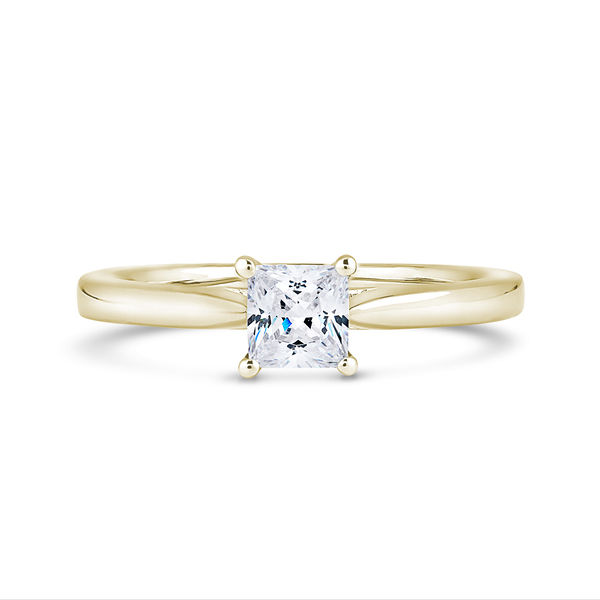
Pear-shaped engagement rings combine one rounded end with a point. That asymmetry gives the design a clear direction, whether the stone sits along the finger, across it or at an angle.
The outline needs careful assessment. A balanced pear should appeal as a whole rather than simply meet a chosen carat weight or length-to-width ratio.
Compare the outline of pear-shaped engagement rings
Look at both sides of the stone. Consider the shoulders, curved end and transition towards the point. A fuller pear and a narrow, elongated pear can feel very different on the hand.
Ask for length and width in millimetres. Then view the stone straight-on. A tilted image can make one shoulder look heavier and complicate comparison.
GIA's pear-shaped diamond guide explains the importance of examining the outline. Use its principles to ask questions about the actual diamond rather than applying a single “perfect” ratio.
Watch the centre as it moves
A pear can show contrasting light and dark areas, including a bow-tie appearance. Watch how those areas change through a video or direct viewing.
Do not judge the stone only under strong spotlights. Request ordinary-light views where available and pay attention to whether one area remains distracting. Some contrast is part of a faceted diamond's pattern; your preference concerns its balance.
Decide how you want to wear the point
There is no compulsory direction. Some wearers prefer the tip towards the fingertip; others prefer the reverse. Angled and east-west designs create another look.
Orientation affects how the ring occupies the hand and how it may sit beside another band. Check that the chosen mounting is designed for the intended arrangement. A ring shown vertically cannot automatically be rotated within its setting.
Protect the pointed end
The tip deserves specific attention in the mounting. Ask how the design protects it and whether the stone has any feature near that area needing professional assessment.
A protective claw or bezel must still suit the actual diamond. The security of a setting depends on construction, fit and condition, not simply the number of claws named in a listing.
Inspect the profile as well. Consider height, cleaning access and how the point sits during ordinary hand movement.
Plan the wedding-band relationship
A pointed centre may extend over the space occupied by a straight wedding band. A contoured or wishbone band can offer a different relationship, but it must be checked against the actual ring.
Compare the pair from above and the side. The aim is a comfortable fit without unwanted pressure against claws or exposed stone edges.
Explore Jewel's pear designs and wedding bands as a coordinated decision rather than separate photographs.
Common questions
Must the point face a certain way?
No. Choose the orientation you enjoy, provided the setting is designed to support it.
Does a longer pear always look better?
No. Length, width and shoulder shape work together. Judge the actual outline.
What is the main practical check?
For pear-shaped engagement rings, confirm deliberate tip protection and a suitable side profile, alongside the diamond's documented specification.