
Diamond education
Centre Stone Weight vs Total Carat Weight: What Are You Buying?
Understand total carat weight for rings, earrings and bracelets. Separate centre weight from side stones and pair totals.
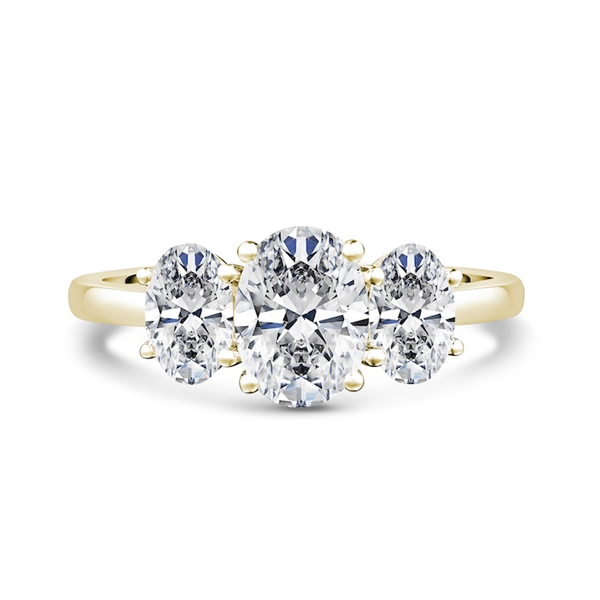
Total carat weight is the combined weight of the diamonds included in the stated total. Centre stone weight describes one principal stone. The distinction matters whenever jewellery contains several diamonds.
A listing saying “1 ct” without explaining its scope leaves an important question unanswered. Before comparing prices, establish which stones the figure includes.
What total carat weight includes
Abbreviations include TCW and CTW. The label should explain whether the figure covers every diamond in a ring, both earrings in a pair, or all stones along a bracelet.
GIA's carat guide explains individual and combined weights. The product specification must make the grouping clear.
A total describes weight, not a particular visual size. Ten small diamonds and one larger diamond can share a combined weight while looking very different.
Read a ring specification in parts
Consider a hypothetical halo ring with a 1.00 ct centre and 0.20 ct of surrounding diamonds. Its total diamond weight is 1.20 ct. Calling it a “1.20 ct ring” does not mean the centre weighs 1.20 ct.
For a trilogy, a 1.50 ct centre plus two 0.25 ct sides produces 2.00 ct total. The sides add coverage and a different composition, but the centre remains 1.50 ct.
These are arithmetic examples, not specifications for Jewel products. Use the exact breakdown for your selected item.
Check the wording for earrings
An equal pair of solitaire studs described as 1.00 ct total contains approximately 0.50 ct per earring. A pair with 1.00 ct in each earring totals approximately 2.00 ct.
Halo earrings introduce another layer. A “combined centre weight” may exclude surrounding diamonds. The finished pair total would include the halos as well. Ask for both figures when comparing.
See the earring weight guide. The same image may illustrate several options, so the written breakdown matters.
Compare bracelets beyond the headline number
A tennis bracelet distributes weight across many stones. Equal totals can involve different lengths, stone counts and individual diamond sizes. Visible width and flexibility may differ.
Record the bracelet length, total weight, stone count where available, and approximate dimensions. Compare the setting and clasp too. A total carat figure cannot replace those construction details.
Keep origin and quality separate
Combined weight does not identify origin, colour, clarity or consistency across a matched group. Establish those independently. A larger total of small stones should not be compared with a single centre solely by adding carats.
Do not assume every accent diamond has its own report. Ask whether stated grades describe each stone, a range or a group specification, and what documents accompany the piece.
Questions to ask before ordering
Ask: “Please confirm the centre weight, side or halo weight, and total diamond weight for my selected option.” For earrings, add “per earring and for the pair.” For bracelets, include length.
Keep that breakdown with the order confirmation. It makes future discussions about the piece easier and ensures you are comparing the same thing.
Common questions
Does 2 ct total mean a 2 ct centre?
Only if explicitly stated. A multi-stone piece may divide the total among several diamonds.
Does total weight determine visible size?
No. Dimensions, arrangement and setting also affect the footprint.
Where can I compare designs?
Explore Jewel's collections and read each selected option. Total carat weight becomes useful when its scope is clear and the rest of the specification sits beside it.