Engagement rings
Oval Diamond Engagement Rings: Proportions, Settings and Buying Tips
Compare oval diamond engagement rings by proportions, bow-tie appearance, setting height and the stone's measurements.
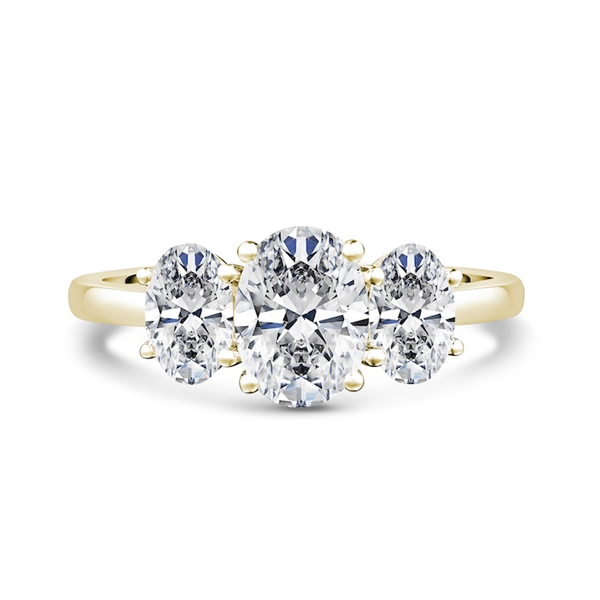
Oval diamond engagement rings offer an elongated outline with softly curved ends. Within that description, the differences can be substantial. A broad oval and a slender oval may carry similar weight while creating very different rings.
Start with the proportions you enjoy, then assess the actual stone's appearance and how the mounting supports it.
Compare oval diamond engagement rings by dimensions
Ask for length and width in millimetres. Dividing length by width gives the length-to-width ratio, a useful description of the outline.
For example, hypothetical dimensions of 9.0 × 6.0 mm produce a ratio of 1.50. This arithmetic describes shape, not an ideal grade. A preferred ratio should never replace checking symmetry, light performance and the actual footprint on the hand.
Compare images at the same scale where possible. A tightly cropped photograph can make a smaller stone appear more substantial than a larger one in a wider frame.
Understand the bow-tie appearance
Some ovals show a darker band across the centre, commonly called a bow tie. Its strength and visual effect can change with lighting, viewing angle and the observer's position.
GIA's guidance on fancy shapes highlights the need to examine individual stones. A single bright still image cannot explain how that pattern behaves in motion.
Look for a pleasing balance across the diamond. Some contrast helps define a lively pattern; the concern is an area that remains distracting to you through normal viewing.
Judge the whole outline
Look at the shoulders and curved ends. Consider whether the left and right sides feel balanced and whether the outline is full or narrow in the places you prefer.
Do not use weight alone to estimate finger coverage. Also compare the width. Two stones with similar length can create different impressions if one is noticeably slimmer.
The diamond-shape guide provides context if you are also considering pear, marquise or round designs.
Choose a setting that suits the profile
Claw position changes how much of the oval edge remains visible. The basket and shoulders determine the side view, support and practical height. Ask to see both front and profile views.
Consider the wedding band before finalising the ring. An oval can extend beyond a narrow shank, and a low basket may prevent a straight band from sitting close. Clearance depends on the actual structure rather than the shape name alone.
Compare the completed specification
Jewel's engagement centres are lab-grown. Compare the selected metal, diamond dimensions, documentation and full price. Make sure any photograph or render is identified as a design example if it does not show the actual selected stone.
Browse the oval engagement selection, then narrow the choice using the profile and measurements.
Common questions
Is there a perfect oval ratio?
No universal ratio suits every preference or stone. Use it to describe shape, then assess appearance.
Will an oval always look larger than a round?
It may create more length, but visible size depends on both stones' dimensions and settings.
What should I prioritise?
Choose oval diamond engagement rings for an outline you enjoy, a balanced appearance in motion and a setting that fits your daily life.