
Sizing and wedding rings
How to Choose a Wedding Band for Your Engagement Ring
Choose a wedding band for your engagement ring by checking profile, metal, width, clearance and contact points.
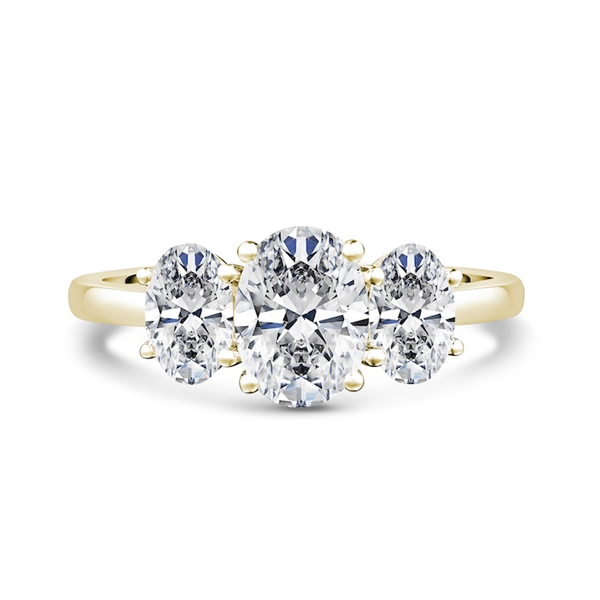
Choosing a wedding band for your engagement ring starts with the profile. The two rings need to work together physically before their widths, colours and details form the look you want.
A photograph from above can suggest a good match while hiding contact beneath the centre. Review the pair from more than one angle.
Check the space around the setting
Look at the engagement ring's basket, bridge and shoulders. Identify where a straight wedding band would sit and whether it would meet metal, claws or exposed diamond edges.
A raised centre may leave useful clearance, but height alone does not guarantee a close fit. The wedding band's own height and shape matter as well.
GIA's settings guide provides terminology for these structural parts. Knowing their names makes a fitting discussion more precise.
Choose a wedding band for your engagement ring as a pair
Try the actual rings together where possible. Otherwise, request side views and relevant dimensions for both.
A straight band offers a clear line. A curved or contoured band follows more of the engagement ring's outline. A wishbone introduces an angled shape that can create space around a projecting centre.
The right choice depends on the exact geometry, not simply the centre's shape name.
Decide whether you want a gap
A visible gap can be an intentional and attractive part of a bridal set. There is no requirement that the rings touch all the way across.
If you want a close fit, avoid achieving it through pressure. The pair should not need to be forced together or push against vulnerable settings. Ask a jeweller to assess any possible contact.
Compare width and visual emphasis
A fine band can keep the centre prominent. A broader band may give the pair more presence. Diamond-set bands add another layer of reflections and may change the balance.
Look at the pair at normal scale. Two delicate rings can feel more substantial together than separately, and a broad stack may fit differently from one narrow ring.
Use the ring-size guide when assessing the combined wearing experience.
Consider metal and surface wear
Matching metal can produce a consistent palette, but mixed colours may also be intentional. Discuss how the materials and finishes will behave where the rings touch.
Do not assume any pairing is immune to wear. Diamond edges and settings deserve particular attention, as do different band heights. Regular inspection helps identify rubbing before it becomes a larger problem.
Think about wearing the band alone
You may sometimes wear only the wedding band. Check whether a strongly shaped design still suits you on its own.
Also consider future stacking. A third ring can change fit and contact points, so leave the decision open until the full arrangement can be assessed.
Explore Jewel's wedding bands beside the engagement-ring specification.
Common questions
Must the two rings use the same metal?
No stylistic rule requires it, but discuss the practical pairing and potential wear.
Does every low setting need a curved band?
No. The actual basket and band dimensions determine the fit.
What is the best starting point?
Choose a wedding band for your engagement ring by confirming comfortable clearance first, then refine the width, metal and detail.